- Preface
- Introduction
- Chapter 1 • The Emergence of Political Parties and the Transformation of Toryism
- Whigs and Namierites
Eighteenth-Century Gradualists
The Defenders of Orthodoxy
Nineteenth-Century Gradualists
The Inter-disciplinary Approach
The Transformation of Toryism
The Influence of Burke
The Transition to Conservatism - Chapter 2 • The Emergent Working Class and Political Relationships, 1800-1832
- Tory Attitudes
The Emergence of the Working Class in the Industrial North-West: An outline of the debate
Working Class Politics before 1820
Working Class Developments in the 1820s
The Working-Class and the Reform Bill
Chapter 3 • The Re-organization of the Conservative Party after 1832
Political Organization before 1832
The Conservatives and the First Reform Act
The Conservatives Organizational Response
Widening the Conservative Appeal
Popular Political Organization: Loyalist Associations
Local Political Organization in the Early Nineteenth-Century
The Middle Classes and Early Political Organization - Chapter 4 • Operative Conservatism: Its Development, Structure, Role and Function
- The Middle Classes and Operative Conservatism
The Development and Structure of Operative Conservatism
Aims, Objectives and Financial Basis of Operative Conservatism
Operative Conservatism and Political Science
The Idioms of Politics and the Role of Issues within Operative Conservatism
Operative Conservatives, Radical Tories and Paternalism
Issues and Political Re-alignments - Chapter 5 • Operative Conservatism and Local Political Developments: Three case studies
- The Market and County Towns
Developments in Lancaster
The Old Industrial Boroughs, Preston: Economic and Social Background
Municipal Politics
Parliamentary Politics
Operative Conservatism in Preston
Chapter 6 • The New Boroughs
The Economic and Social Structure of Blackburn
Early Working Class Militancy
Reform and Parliamentary Politics in Blackburn
The Political Culture of Blackburn
Political Organization in Blackburn
The Role of Issues and Working Class Politics
Developments in Bolton and the South of the Region - Chapter 7 • Working Class Political Integration and the Conservative Party
- Appendices
- Bibliography
- Index
a breviary stuff original
268pp / 191x235mm / paperback
ISBN 978-0-9570005-0-6
Unite the Union's Book of the Month, January 2017.
268pp / 191x235mm / paperback
ISBN 978-0-9570005-0-6
Unite the Union's Book of the Month, January 2017.
David Walsh – Making Angels in Marble
The Conservatives, the Early Industrial Working Class and Attempts at Political Incorporation
£15.00
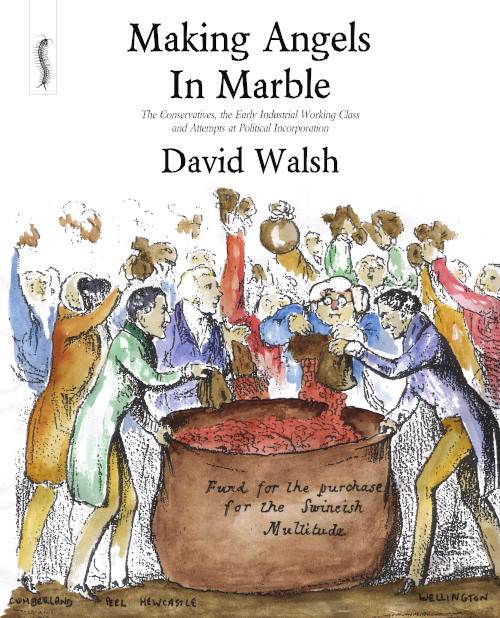
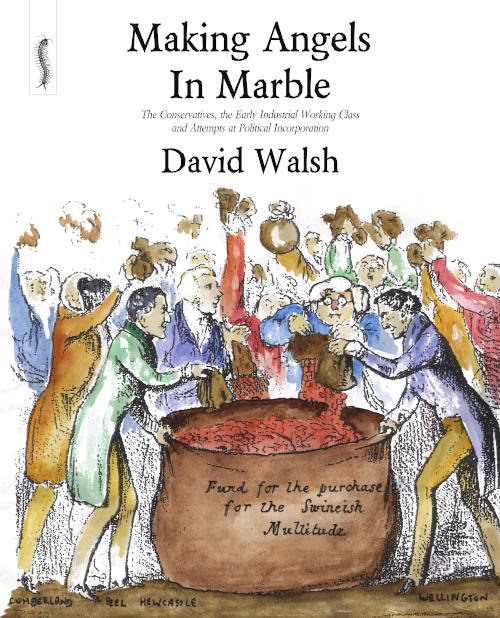
In the first elections called under the terms of the 1832 Reform Act the Tory party appeared doomed. They had recorded their worst set of results in living memory and were organizationally in disarray as well, importantly, seemingly completely out of touch with the current political mood. During the intense pressure brought to bear by the supporters of political reform was the use of “pressure from without” and in this tactic the industrial working class were highly visible. Calls for political reform had been growing since the 1760s and given fresh impetus with the revolutions in America and France respectively. The old Tory party had been resistant to all but the most glaring corruption and abuse under the pre-Reform system, not least to the idea of extending the electoral franchise to the ‘swineish multitude’, as Edmund Burke notoriously described the working class. Yet within five years after the passing of reform the Conservatives — the natural heirs to the old Tory party — were attempting to politically incorporate sections of the working class into their ranks. This book examines how this process of making these ‘Angels in Marble’, to use Disraeli’s phrase from a later era, took shape in the 1830s. It focuses on how a section of the industrial working class became the target of organizational inclusion into Peelite Conservatism and ultimately into the British party political system.