


- Abbreviations
- About the author
- Acknowledgements
- Introduction
- Part 1: Ireland: Radical Apprenticeship, c. 1774-1799
- 1 Early Years
- 2 The Making of a Radical: Apprentice Years
- 3 Trial and Imprisonment, 1797-1799
- Part 2: England: Parliamentary Reporting and Electioneering Activity, 1799-1809
- 4 London: Early Years: 1799-1802
- 5 ‘Green’ Finnerty: Electioneering and Political Activity, 1802-1808
- 6 The Duke of York Scandal, 1808-1809
- 7 ‘Libelling a Libeller?’: Finnerty vs. Tipper, 1809
- Part 3: From Walcheren to Lincoln Prison, 1809-1810
- 8 The Walcheren Expedition, 1809-1810
- 9 Challenging Castlereagh, 1810
- 10 ‘Petition, Petition, Petition’: Finnerty and the Catholic Committee, November 1810
- 11 Finnerty’s Second Libel Trial, 1811
- Part 4: ‘The Celebrated Mr. Finnerty’: 1811-1822
- 12 In Lincoln Prison, 1811-1812
- 13 Political Activism in Prison and on Release
- 14 Radicalism in Transition, 1812-1817
- 15 Peterloo and its Aftermath, 1819-1820
- 16 Later Years and Death, 1820-1822
- Conclusion
- Bibliography
- Index
Special Price
A Breviary Stuff Original
256pp / 156x234mm / paperback
ISBN 978-1-9161586-6-5
256pp / 156x234mm / paperback
ISBN 978-1-9161586-6-5
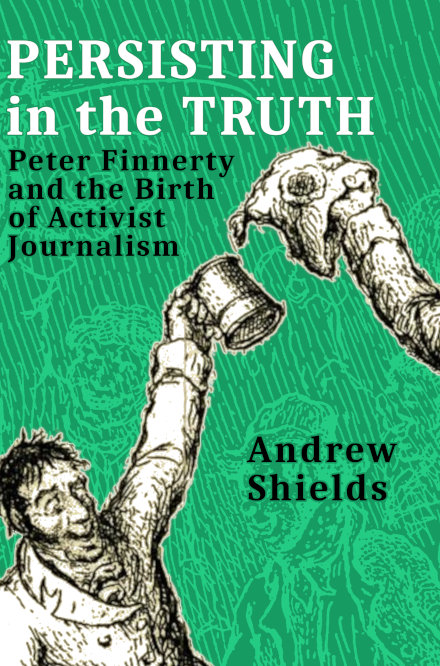
Andrew Shields – Persisting in the Truth
Peter Finnerty and the Birth of Activist Journalism
Original price was: £18.00.£15.00Current price is: £15.00.
Peter Finnerty (c.1774-1822) was one of the most combative and consequential journalists of the Age of Revolutions. Despite this, historians have long overlooked his key role in helping to shape radical politics in England and Ireland in this period. The book delineates Finnerty’s role as a crucial link between the Irish radical movement of the late eighteenth century and its counterpart in Britain in the first quarter of the nineteenth century. It evaluates his ideas, his public life in both England and Ireland, and the legacy he left behind for those radical journalists who followed in his footsteps.
Finnerty’s turbulent career involved him in two notorious libel trials in 1797 and 1810. The first of which left him with little choice but to leave Ireland and essentially forced him to pursue a new career in England. During his years as a courageous and crusading journalist there, he frequently exposed corruption in high places, most notably in the Duke of York scandal of 1809. Subsequently, through his reporting on the Walcheren expedition in 1809 and the Peterloo massacre of 1819, Finnerty exposed the inhumanity of the governments then in power in Britain.
Throughout his frequent clashes with Lord Castlereagh, the senior Tory politician whom he saw as his nemesis, Finnerty maintained his fervent commitment to the ideal of the freedom of the press. His willingness to accept the costs this entailed resulted in his serving two prison terms. Finnerty was also determined that the public should have free access to the information they needed to understand and give informed consent to the policies pursued by government. In this respect, he was a democratic writer whose ideas retain their relevance and power today.
Histories of the struggle for a free press in early nineteenth century Britain rarely have that much to say about radical Irish journalist, Peter Finnerty. The customary focus has either been on well-known editors and propagandists like Henry Hetherington (Poor Man’s Guardian), Richard Carlile (the Gauntlet and the Republican), Thomas Wooler (Back Dwarf) and William Cobbett (Weekly Register) or on the hundreds of less celebrated men and women gaoled for hawking unstamped papers about the streets. Finnerty didn’t do that, nor did he own a radical paper. But however unfamiliar his name may be, this is the book to convince you of his significance.
Finnerty was never a steadfast advocate of universal manhood suffrage; his radicalism was of a more cautious kind, but he had an undeniably good nose for a cover-up and never shirked a fight. He started life as a Dublin printer and ended it in London as a journalist for one of the most widely circulated liberal newspapers, the Morning Chronicle. A former member of the United Irishmen and printer of its paper, The Press, Finnerty was a well-known figure in London and Irish radical circles, a ready voice at political debates and meetings and a staunchly independent advocate of journalistic freedom.
He was a plain speaker. As one of his friends put it in 1810, he was ‘neither learned or polished but in command of a great flow of fluent and forcible language’. And it landed him in trouble frequently enough, earning him an hour in the Dublin pillory and some prison time for libel in 1797. He narrowly avoided a second trial in 1809 as the publisher and probable author of a pamphlet exposing Mary Anne Clarke, mistress of army commander in chief, the Duke of York, for selling commissions. The resulting scandal forced the Duke’s resignation, and when establishment papers turned on Finnerty as an Irish upstart, he fought back with a libel suit of his own against the editor of one popular Tory paper, The Satirist. Victory in court earned him a derisory shilling in damages.
Finnerty’s journalism was fiercely independent. Although nominally attached to the government’s ill-fated attempt to capture French-held towns in the Netherlands in 1810 (the ‘Walcheren expedition’), he quickly became critical of its planning as initial military victories gave way to deadly outbreaks of fever amongst the soldiers. Finnerty’s damning press reports were the cause of his forced removal as an embedded reporter, and he vowed revenge, principally upon the Irish peer, Viscount Castlereagh.
There were two main bones of contention, first Castlereagh’s inept miliary planning and, second, his earlier role in subduing the Irish rebellion in 1798. Finnerty attacked him in an open letter published in the Morning Chronicle, for permitting the torture and flogging of rebel prisoners and running a regime of ‘tyranny, cruelty and oppression’, in Ireland. Consequently, he found himself the subject of a libel suit once again, and he gathered plenty of evidence from victims with which to mount a defence. All the allegations, he maintained, were demonstrably true. Like Robert Emmet before him, and like Thomas Wooler and William Hone a few years later, Finnerty used the witness box as a theatrical platform for repeating and amplifying the charges. Unfortunately judges were apt to define libel as anything that might hurt the subject’s feelings or bring them into public contempt. Finnerty had accused Castlereagh of abusing his office for the ‘gratification of his private malice’, and the court ruled that to be libelous regardless of whether or not it was true.
The eighteen-month sentence handed down to Finnerty on conviction was enough to persuade him to hone his future talents as a journalist on campaigns to reform the libel laws and English prison conditions. All of this, together with his theatrically managed trial defence, raised his profile in radical political circles and brought him to much wider public attention. Finnerty filed lengthy reports for the Morning Chronicle on radical meetings and show trials in the post-war era. He was at Spa Fields in 1816, at the brutal sentencing of Jeremah Brandreth and the Pentrich rebels at Derby in 1817, and in 1819 at the staged inquests that followed the Peterloo massacre (where he got into a number of rows with the obstructive coroner over the right to report the proceedings freely). He called out other journalists for misreporting events like these as government hirelings and exposed ministers’ widespread use of spies and agents provocateur for the entrapment of radical activists.
Finnerty’s interventions in the dogged pursuit of truth, argues Andrew Shields, can be regarded as ‘the birth of activist journalism’. Rather than file copy for avowedly radical papers, Finnerty exposed government malpractice and corruption from the inside, producing uncompromising journalism for the more widely read mainstream press. Between 1810 and 1812, and alongside Cobbett, says Shields, Finnerty was probably the best known radical journalist in Britain. Persisting in the Truth is a meticulously researched work of political biography and an important addition to Breviary Stuff’s growing catalogue of original radical histories.
Steve Poole, Emeritus Professor of History and Heritage, University of the West of England, Bristol Review first published on the Bristol Radical History Group website, https://www.brh.org.uk/site/book-reviews/persisting-in-the-truth/
Finnerty was never a steadfast advocate of universal manhood suffrage; his radicalism was of a more cautious kind, but he had an undeniably good nose for a cover-up and never shirked a fight. He started life as a Dublin printer and ended it in London as a journalist for one of the most widely circulated liberal newspapers, the Morning Chronicle. A former member of the United Irishmen and printer of its paper, The Press, Finnerty was a well-known figure in London and Irish radical circles, a ready voice at political debates and meetings and a staunchly independent advocate of journalistic freedom.
He was a plain speaker. As one of his friends put it in 1810, he was ‘neither learned or polished but in command of a great flow of fluent and forcible language’. And it landed him in trouble frequently enough, earning him an hour in the Dublin pillory and some prison time for libel in 1797. He narrowly avoided a second trial in 1809 as the publisher and probable author of a pamphlet exposing Mary Anne Clarke, mistress of army commander in chief, the Duke of York, for selling commissions. The resulting scandal forced the Duke’s resignation, and when establishment papers turned on Finnerty as an Irish upstart, he fought back with a libel suit of his own against the editor of one popular Tory paper, The Satirist. Victory in court earned him a derisory shilling in damages.
Finnerty’s journalism was fiercely independent. Although nominally attached to the government’s ill-fated attempt to capture French-held towns in the Netherlands in 1810 (the ‘Walcheren expedition’), he quickly became critical of its planning as initial military victories gave way to deadly outbreaks of fever amongst the soldiers. Finnerty’s damning press reports were the cause of his forced removal as an embedded reporter, and he vowed revenge, principally upon the Irish peer, Viscount Castlereagh.
There were two main bones of contention, first Castlereagh’s inept miliary planning and, second, his earlier role in subduing the Irish rebellion in 1798. Finnerty attacked him in an open letter published in the Morning Chronicle, for permitting the torture and flogging of rebel prisoners and running a regime of ‘tyranny, cruelty and oppression’, in Ireland. Consequently, he found himself the subject of a libel suit once again, and he gathered plenty of evidence from victims with which to mount a defence. All the allegations, he maintained, were demonstrably true. Like Robert Emmet before him, and like Thomas Wooler and William Hone a few years later, Finnerty used the witness box as a theatrical platform for repeating and amplifying the charges. Unfortunately judges were apt to define libel as anything that might hurt the subject’s feelings or bring them into public contempt. Finnerty had accused Castlereagh of abusing his office for the ‘gratification of his private malice’, and the court ruled that to be libelous regardless of whether or not it was true.
The eighteen-month sentence handed down to Finnerty on conviction was enough to persuade him to hone his future talents as a journalist on campaigns to reform the libel laws and English prison conditions. All of this, together with his theatrically managed trial defence, raised his profile in radical political circles and brought him to much wider public attention. Finnerty filed lengthy reports for the Morning Chronicle on radical meetings and show trials in the post-war era. He was at Spa Fields in 1816, at the brutal sentencing of Jeremah Brandreth and the Pentrich rebels at Derby in 1817, and in 1819 at the staged inquests that followed the Peterloo massacre (where he got into a number of rows with the obstructive coroner over the right to report the proceedings freely). He called out other journalists for misreporting events like these as government hirelings and exposed ministers’ widespread use of spies and agents provocateur for the entrapment of radical activists.
Finnerty’s interventions in the dogged pursuit of truth, argues Andrew Shields, can be regarded as ‘the birth of activist journalism’. Rather than file copy for avowedly radical papers, Finnerty exposed government malpractice and corruption from the inside, producing uncompromising journalism for the more widely read mainstream press. Between 1810 and 1812, and alongside Cobbett, says Shields, Finnerty was probably the best known radical journalist in Britain. Persisting in the Truth is a meticulously researched work of political biography and an important addition to Breviary Stuff’s growing catalogue of original radical histories.
Steve Poole, Emeritus Professor of History and Heritage, University of the West of England, Bristol Review first published on the Bristol Radical History Group website, https://www.brh.org.uk/site/book-reviews/persisting-in-the-truth/