


- Abbreviations
- About the Author
- Foreword
- 1 Introduction
- Policing prior to 1848
- Part 1: Policing Under the Improvement Commissions, 1848-68
- 2 Creating a Force
- Managing the force: superintendents and the watch committee
- Inspectors and sergeants
- The men on the beat
- Conclusion
- 3 Crime and Criminals
- Serious crime – a criminal class?
- Petty crime
- The police and the public: conflict or consent?
- Part 2: Policing After Incorporation
- 4 Refounding and Modernizing the Force
- Police discipline
- Ill-health and injury
- A snapshot of indiscipline, ill-health and efficiency: Huddersfield, January 1895
- Conclusion
- 5 Police Work and the Community
- Drunkenness and the demise of the beerhouse/brothel
- Gambling
- Vagrancy and offences against the bye-laws
- Traffic
- Public gatherings and industrial disputes
- Conclusion: conflict and consent – popular responses to the police
- 6 Conclusion - Huddersfield, a Policed Society?
- Bibliographical note
- Index
Special Price
A Breviary Stuff Original
132pp / 156x234mm / paperback
ISBN 978-1-9161586-5-8
132pp / 156x234mm / paperback
ISBN 978-1-9161586-5-8
David Taylor – Beats, Backstreets and Brothels
Policing Victorian Huddersfield
Original price was: £12.99.£10.00Current price is: £10.00.
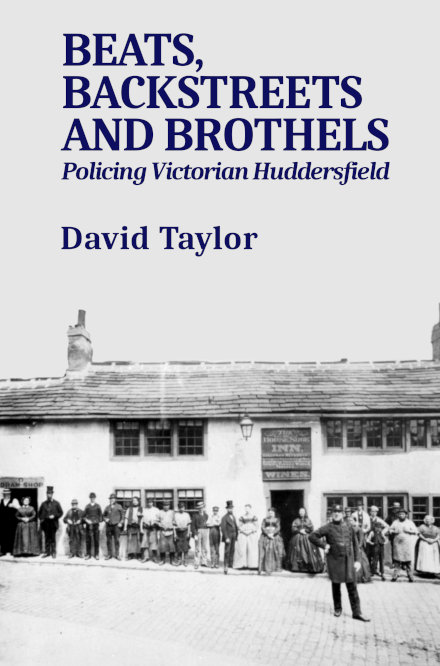
Huddersfield was one of a number of prosperous northern towns in Victorian England. The town grew dramatically in size as it became the undisputed centre of the fancy woollen trade with a world-wide reputation for quality. The prosperity of the town was reflected in its architecture – its much-praised railway station, the Ramsden Estate building and the elegant villas of Edgerton – but there was a darker side to the town, exemplified by the notorious Castlegate, site of numerous beerhouses and brothels. The challenge for local politicians and civic leaders was to create appropriate institutions and instigate reforms which would bring ‘order and decorum’ to the town. The ‘new’ police were a central element and this book explores the creation of a policed society in the years from their introduction in late-1848 to the end of Victoria’s reign.
Two themes run through this book: the development of the police force and its impact on local society. In charting the evolution of the police force, the problems of creating a disciplined and effective force are given a human face through an examination of the experiences of individual officers. It is, in part, a story of hard graft, solid service and success but it is also a story of indiscipline, incompetence and illness. The myriad interactions between police and public, the realities behind the notion of ‘policing by consent,’ are explored in terms of individual experiences, from the anti-police activities of the Irish Small Gang, to members of the town’s precariat, sleeping rough by the lime kilns or in disused cellars, and also to boys and young men, collecting together to play pitch and toss in various parts of the town, only to disperse before a frustrated policeman could lay hands on them. Huddersfield policemen were often flawed and their potential powers were limited in practice. Nonetheless, over time they were accepted, albeit begrudgingly at times, and became as much a part of the urban environment as the mills which made the town.