


- Abbreviations
- About the Author
- Foreword
- 1 Introduction
- Policing prior to 1848
- Part 1: Policing Under the Improvement Commissions, 1848-68
- 2 Creating a Force
- Managing the force: superintendents and the watch committee
- Inspectors and sergeants
- The men on the beat
- Conclusion
- 3 Crime and Criminals
- Serious crime – a criminal class?
- Petty crime
- The police and the public: conflict or consent?
- Part 2: Policing After Incorporation
- 4 Refounding and Modernizing the Force
- Police discipline
- Ill-health and injury
- A snapshot of indiscipline, ill-health and efficiency: Huddersfield, January 1895
- Conclusion
- 5 Police Work and the Community
- Drunkenness and the demise of the beerhouse/brothel
- Gambling
- Vagrancy and offences against the bye-laws
- Traffic
- Public gatherings and industrial disputes
- Conclusion: conflict and consent – popular responses to the police
- 6 Conclusion - Huddersfield, a Policed Society?
- Bibliographical note
- Index
Special Price
A Breviary Stuff Original
132pp / 156x234mm / paperback
ISBN 978-1-9161586-5-8
132pp / 156x234mm / paperback
ISBN 978-1-9161586-5-8
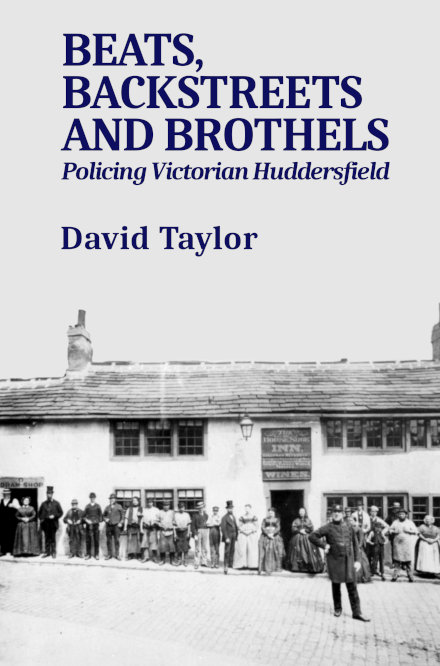
David Taylor – Beats, Backstreets and Brothels
Policing Victorian Huddersfield
Original price was: £12.99.£10.00Current price is: £10.00.
Huddersfield was one of a number of prosperous northern towns in Victorian England. The town grew dramatically in size as it became the undisputed centre of the fancy woollen trade with a world-wide reputation for quality. The prosperity of the town was reflected in its architecture – its much-praised railway station, the Ramsden Estate building and the elegant villas of Edgerton – but there was a darker side to the town, exemplified by the notorious Castlegate, site of numerous beerhouses and brothels. The challenge for local politicians and civic leaders was to create appropriate institutions and instigate reforms which would bring ‘order and decorum’ to the town. The ‘new’ police were a central element and this book explores the creation of a policed society in the years from their introduction in late-1848 to the end of Victoria’s reign.
Two themes run through this book: the development of the police force and its impact on local society. In charting the evolution of the police force, the problems of creating a disciplined and effective force are given a human face through an examination of the experiences of individual officers. It is, in part, a story of hard graft, solid service and success but it is also a story of indiscipline, incompetence and illness. The myriad interactions between police and public, the realities behind the notion of ‘policing by consent,’ are explored in terms of individual experiences, from the anti-police activities of the Irish Small Gang, to members of the town’s precariat, sleeping rough by the lime kilns or in disused cellars, and also to boys and young men, collecting together to play pitch and toss in various parts of the town, only to disperse before a frustrated policeman could lay hands on them. Huddersfield policemen were often flawed and their potential powers were limited in practice. Nonetheless, over time they were accepted, albeit begrudgingly at times, and became as much a part of the urban environment as the mills which made the town.
This is a book that demonstrates, once again, the usefulness of local studies in a well-worked field. We are not short of books on nineteenth century policing; indeed the author of this one has covered the ground extensively enough, with recent work on the West Riding, an older case study of Middlesborough, and a ‘crime, policing and punishment’ textbook that first appeared on student reading lists in 1998. Although parliamentary legislation ensured that, in theory at least, all towns and counties established professional police forces by the middle years of the nineteenth century, they did not all do so in a uniform manner, or in uniform circumstances. David Taylor’s new book takes a deep dive into the successes and failures of early policing in one Northern industrial town, Huddersfield, and poses the question, what is a ‘policed society’ and what were the implications of living in one?
English towns with the status of municipal borough were obliged to establish a watch committee after 1835, and most produced a trained and professional force soon after that. Bristol for example, both a borough and a county, established its own police force in 1836. But Huddersfield, in common with a great many other northern industrial centres, was not made a municipal borough until 1868. Despite its role as a rapidly expanding centre for the Yorkshire woollen trade, Huddersfield remained under the antiquated governance of its manor and parish authorities until local Improvement Acts were obtained in 1820 and 1848. The second of these, in the year of European revolutions and the final moments of Chartism, provided the town with its new police force.
It goes without saying perhaps, that nineteenth century reformers presented traditional forms of ad hoc low-level policing as inefficient, out of touch with the demands of an expanding population and prone to corruption. In simplistic terms, the replacement of small handfuls of part time constables and elderly watchmen clutching rattles and lanterns by new bodies of paid and professionally trained police should have meant an end to order by negotiation and the beginnings of coercive social control. But in practice change was rarely quite so cathartic. To begin with, until 1868, the police’s jurisdiction was confined to the old town boundaries, a distance no greater than 1200 yards from the centre. Secondly, the initial force in 1848 was small; three officers and seventeen constables, only three of whom were reserved for daylight duties. Expansion was gradual and it was not until the 1860s that the numbers reached 200.
Taylor approaches the impact of the new force in two ways, considering firstly its management; the efficiency and turn-over of recruits, and its development as a functioning institution; and secondly its interaction with local communities. The latter is achieved by examining the role of the police in specific circumstances; in combatting street violence for example, regulating beer houses, or intervening during industrial disputes.
One very likely consequence of the introduction of professional police in any town is a rise in the number of people taken up and arrested. Statistical evidence like this obviously prompts questions about the impact of improved policing on serious crime rates. But while a busy looking force may certainly have played well with wealthier townsfolk in persuading them that their property was more secure, in practice people were more likely to be arrested for using obscene language in the street or promiscuous dancing in a beer house than for an indictable property offence.
Earlier studies have portrayed the police as ‘social missionaries’ in this respect, agents of social control and moral rectitude in ungodly working class districts. Taylor is wary of such blunt explanations. That Huddersfield gradually became a policed, or regulated society is undeniable, he argues, ‘and its citizens knew it as they came into contact with the law and its agents’ in many aspects of their daily lives. But Huddersfield does not provide evidence of overt physical hostility to the new police on anything like the same scale as nearby Bradford or Leeds, which suggests that local factors played a significant role in social relations and that a degree of tolerance for low-level criminality may have been required for any version of policing ‘by consent’ to develop. The police were never much liked, he concludes, but nevertheless became an accepted part of the urban environment.
Taylor considers the impact of soft policing as well as hard. The opening ceremony for a new public park in 1883 for instance, attracted large crowds who, it was reasoned, must be ‘held back’ by the police, to maintain order. This operation was only made possible by the drafting in of extra constables from neighbouring towns, and in the consequent imposition of ‘order’, some of the townsfolk were injured. We might wonder how differently the day may have played out if the police had not taken it upon themselves to marshal and contain the crowd. Whatever the answer, the presence of police clearly changed the nature of the event and indicated new rules governing acceptable behaviour in public space
Historians, infers Taylor, would do well to take greater notice of local and regional nuances in the management of the early police. Implicit in this book is a recognition that psychology helps to shape the attitudes of both police and public to the regulation of daily life. We need to understand the character of key individuals in the local hierarchy – the superintendents, inspectors, sergeants and ordinary constables – the length of time they remained in post, and the relationship they forged with the town authorities to whom they were answerable. Unlike many books on the early police, Taylor’s is peppered throughout by the lives and experience of the otherwise barely known working class men who answered recruitment adverts and turned up for duty. Digging out biographies of men like these from fragmentary archival sources is not always easy. Beats, Backstreets and Brothels shows not only how it can be done but that it ought to be.
Steve Poole, Emeritus Professor of History and Heritage, University of the West of England, Bristol Review first published on the Bristol Radical History Group website, https://www.brh.org.uk/site/book-reviews/beats-backstreets-and-brothels//
English towns with the status of municipal borough were obliged to establish a watch committee after 1835, and most produced a trained and professional force soon after that. Bristol for example, both a borough and a county, established its own police force in 1836. But Huddersfield, in common with a great many other northern industrial centres, was not made a municipal borough until 1868. Despite its role as a rapidly expanding centre for the Yorkshire woollen trade, Huddersfield remained under the antiquated governance of its manor and parish authorities until local Improvement Acts were obtained in 1820 and 1848. The second of these, in the year of European revolutions and the final moments of Chartism, provided the town with its new police force.
It goes without saying perhaps, that nineteenth century reformers presented traditional forms of ad hoc low-level policing as inefficient, out of touch with the demands of an expanding population and prone to corruption. In simplistic terms, the replacement of small handfuls of part time constables and elderly watchmen clutching rattles and lanterns by new bodies of paid and professionally trained police should have meant an end to order by negotiation and the beginnings of coercive social control. But in practice change was rarely quite so cathartic. To begin with, until 1868, the police’s jurisdiction was confined to the old town boundaries, a distance no greater than 1200 yards from the centre. Secondly, the initial force in 1848 was small; three officers and seventeen constables, only three of whom were reserved for daylight duties. Expansion was gradual and it was not until the 1860s that the numbers reached 200.
Taylor approaches the impact of the new force in two ways, considering firstly its management; the efficiency and turn-over of recruits, and its development as a functioning institution; and secondly its interaction with local communities. The latter is achieved by examining the role of the police in specific circumstances; in combatting street violence for example, regulating beer houses, or intervening during industrial disputes.
One very likely consequence of the introduction of professional police in any town is a rise in the number of people taken up and arrested. Statistical evidence like this obviously prompts questions about the impact of improved policing on serious crime rates. But while a busy looking force may certainly have played well with wealthier townsfolk in persuading them that their property was more secure, in practice people were more likely to be arrested for using obscene language in the street or promiscuous dancing in a beer house than for an indictable property offence.
Earlier studies have portrayed the police as ‘social missionaries’ in this respect, agents of social control and moral rectitude in ungodly working class districts. Taylor is wary of such blunt explanations. That Huddersfield gradually became a policed, or regulated society is undeniable, he argues, ‘and its citizens knew it as they came into contact with the law and its agents’ in many aspects of their daily lives. But Huddersfield does not provide evidence of overt physical hostility to the new police on anything like the same scale as nearby Bradford or Leeds, which suggests that local factors played a significant role in social relations and that a degree of tolerance for low-level criminality may have been required for any version of policing ‘by consent’ to develop. The police were never much liked, he concludes, but nevertheless became an accepted part of the urban environment.
Taylor considers the impact of soft policing as well as hard. The opening ceremony for a new public park in 1883 for instance, attracted large crowds who, it was reasoned, must be ‘held back’ by the police, to maintain order. This operation was only made possible by the drafting in of extra constables from neighbouring towns, and in the consequent imposition of ‘order’, some of the townsfolk were injured. We might wonder how differently the day may have played out if the police had not taken it upon themselves to marshal and contain the crowd. Whatever the answer, the presence of police clearly changed the nature of the event and indicated new rules governing acceptable behaviour in public space
Historians, infers Taylor, would do well to take greater notice of local and regional nuances in the management of the early police. Implicit in this book is a recognition that psychology helps to shape the attitudes of both police and public to the regulation of daily life. We need to understand the character of key individuals in the local hierarchy – the superintendents, inspectors, sergeants and ordinary constables – the length of time they remained in post, and the relationship they forged with the town authorities to whom they were answerable. Unlike many books on the early police, Taylor’s is peppered throughout by the lives and experience of the otherwise barely known working class men who answered recruitment adverts and turned up for duty. Digging out biographies of men like these from fragmentary archival sources is not always easy. Beats, Backstreets and Brothels shows not only how it can be done but that it ought to be.
Steve Poole, Emeritus Professor of History and Heritage, University of the West of England, Bristol Review first published on the Bristol Radical History Group website, https://www.brh.org.uk/site/book-reviews/beats-backstreets-and-brothels//